
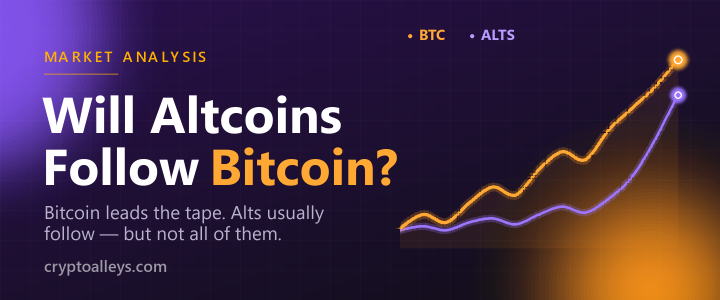
Will Alt Coin Follow Bitcoin
Every time Bitcoin puts together a serious run, the same question starts circulating: when do the altcoins move? It is one of the oldest reflexes in this market, and for good reason the pattern has repeated often enough that traders treat it as gospel. But “alts follow Bitcoin” is a rule of thumb, not a law of physics, and the version of this market we are in now is structurally different from the one that produced the alt seasons people remember.
Here is what actually drives the rotation, the signals worth watching, and the reasons this cycle may not rhyme as neatly as the last one.
Why Altcoins Usually Follow
The rotation is not mystical. It is liquidity and risk appetite moving through the market in a fairly predictable order.
When Bitcoin rallies hard, it pulls in fresh capital and Bitcoin is the on-ramp. New money arrives in BTC because it is the asset with the deepest liquidity, the clearest narrative, and the most institutional plumbing behind it. That capital sits there while the move is still uncertain.
Then two things happen. Early Bitcoin buyers end up sitting on gains and start looking for higher beta assets that move more per dollar of risk. And newer participants, having watched BTC run without them, go hunting for the “next” thing at a lower unit price. Both flows point the same direction: down the risk curve.
That produces the classic sequence:
- Bitcoin leads and absorbs the initial inflow
- Ethereum and the major L1s catch a bid as capital gets more comfortable
- Large-cap alts follow, usually with a lag of weeks, not days
- Mid and small caps move last, fastest, and most violently
Each step down that ladder means thinner liquidity and bigger percentage swings in both directions. That is the whole appeal, and the whole danger.
The Signals That Actually Matter
If you want to track whether a rotation is genuinely underway rather than just hoped for, these are the things worth watching. None of them is a trigger on its own, they matter as a cluster.
📊 Bitcoin dominance. BTC’s share of total crypto market cap. A rotation into alts shows up as dominance rolling over and trending down while total market cap holds or rises. Dominance falling because Bitcoin is dumping is not alt season that is just everything bleeding at different speeds.
📈 The ETH/BTC ratio. Ethereum is the traditional gateway to the rest of the risk curve. If ETH cannot gain on BTC, the capital behind it usually has not committed to moving further out either.
💵 Stablecoin supply and exchange inflows. Growing stablecoin supply means dry powder entering the system rather than money simply rotating between assets already inside it. Rotation without new capital is a zero-sum game something has to bleed for something else to run.
🔥 Funding rates and open interest. Rising open interest with sane funding suggests real positioning. Funding spiking to extremes suggests a crowded, leveraged trade that tends to resolve through a liquidation cascade rather than a sustained trend.
🔄 Alt volume share. Price without volume is noise. If altcoin volume is not meaningfully expanding as a share of the total, the “move” is a handful of thin books being pushed around.
Why This Cycle May Not Rhyme
This is the part that usually gets skipped, and it is the part that matters most.
The denominator exploded. The alt seasons people are nostalgic for happened when the investable universe was a few hundred tokens. It is now measured in millions, with new ones launching continuously and near-frictionlessly. The same dollar of rotating capital is spread across an incomparably wider surface. A rising tide genuinely does not lift all boats anymore — most of them stay on the bottom.
Institutional capital does not rotate the same way. A meaningful share of Bitcoin demand now arrives through regulated wrappers and treasury allocations. That money bought an approved, mandated exposure. It largely does not sell BTC to buy a mid-cap token that is not what its mandate permits. Capital that cannot rotate does not create alt season no matter how much of it arrives.
Supply overhangs are scheduled. Many newer tokens launched with small floats and multi-year unlock calendars. Rallies in those names run directly into programmed supply hitting the market. Price can rise and still be absorbed entirely by unlocks.
Attention is now the scarce resource. Speculative energy that once spread across a broad basket of alts increasingly concentrates into short, brutal cycles in whatever is currently in focus. That produces rotations, plural narrower, faster, and far less forgiving than a broad market-wide melt-up.
What A Real Alt Season Looks Like
If the rotation is genuine rather than wishful, you tend to see most of these at once:
- BTC dominance trending down while total market cap climbs
- ETH/BTC breaking and holding above a prior range
- Stablecoin supply expanding, not just circulating
- Breadth gains showing up across sectors, not in one narrative
- Alt volumes rising as a share of total, sustained over weeks
- Bitcoin going quiet and ranging rather than crashing
That last one is underrated. Alts historically perform best when Bitcoin is stable and boring, not when it is making headlines. Violent BTC moves in either direction tend to pull liquidity back toward the center.
The Risk Nobody Prices Properly
Higher beta cuts both ways, and the downside is not symmetrical with the upside.
Altcoins fall harder and recover slower. Drawdowns of 80–90% from cycle highs are routine rather than exceptional, and a large share of tokens from any given cycle never reclaim their highs at all. Thin order books that make a token easy to pump make it equally easy to gap through on the way down, and liquidity has a habit of vanishing exactly when you want to exit.
The uncomfortable historical record is that the majority of altcoins underperform Bitcoin over a full cycle. The ones that dominate the highlight reels are heavy survivorship bias.
The Bottom Line
Altcoins have historically followed Bitcoin, and the mechanism behind that liquidity working its way down the risk curve is still intact. What has changed is the size of the field it has to spread across and the character of the money arriving.
The realistic expectation is not a repeat of a market-wide melt-up where everything runs. It is narrower, faster, more selective rotations, where the gap between the assets that participate and the ones that do not is far wider than it used to be. “Will alts follow?” is probably the wrong question. Which ones, and for how long is the better one.
Watch dominance. Watch breadth. Watch whether new capital is actually entering the system. And treat any single indicator with suspicion.
👉 Track the coins you are watching on CryptoAlleys explore listings, follow projects, and keep everything you are monitoring in one place.
Disclaimer: This article is for informational and educational purposes only and does not constitute financial, investment, or trading advice. Cryptocurrency markets are highly volatile and you can lose your entire capital. Nothing here is a recommendation to buy or sell any asset. Always do your own research and consider consulting a licensed financial professional before making investment decisions.